

- Diese Veranstaltung hat bereits stattgefunden.
What Trauma Tells Us About Ourselves as Nations – A Discussion with Asal Dardan and Karolina Wigura
Invitation
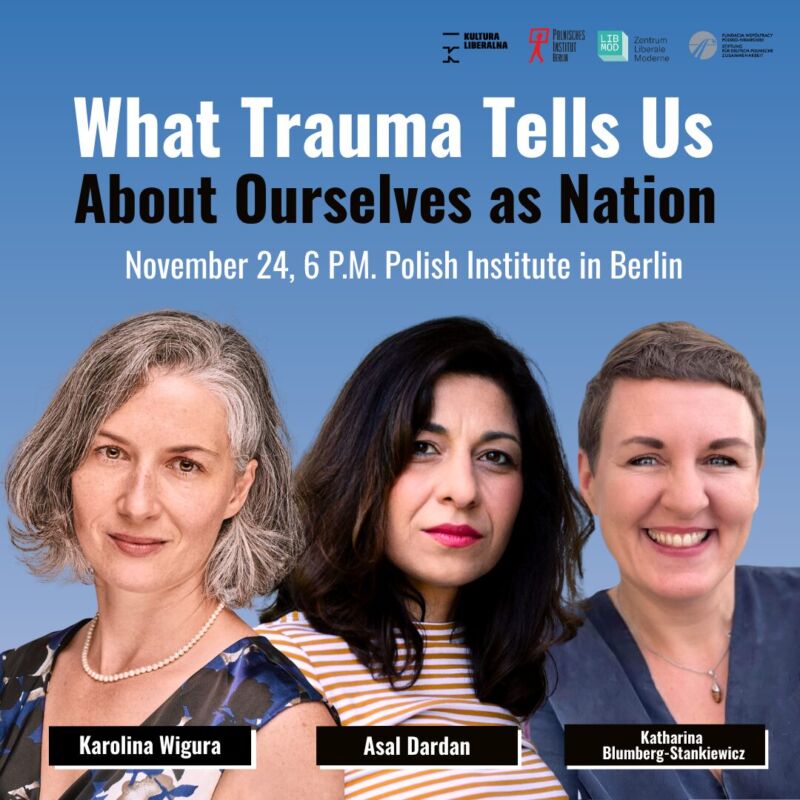
What Trauma Tells Us About Ourselves as Nations -
A Discussion with Asal Dardan and Karolina Wigura
Date: Monday, 24. November 2025
Time: 06 p.m. – 8 p.m.
Place: Polish Institute in Berlin, Burgstraße 27, 10178 Berlin
Do traumatic experiences shape nations and societies? If so, how? In the case of Poland, historical traumas seem to leave Poles fearful, anxious, and unhappy. Yet, in moments of crisis, these traumas enable them to mobilize and prepare to fight. Germany’s history of violence against ethnic and social groups has permanently raised questions about victimhood, guilt, and belonging.
History shapes our contemporary relationships, obsessions, and fears. What causes this, and how can one break free from it? Are we doomed to constantly remind ourselves of our difficult history? Is trauma passed down through generations? What does trauma reveal about Poles and Germans? What unites and divides us? How has history shaped our daily behaviors, fears, and obsessions? During the debate, Asal Dardan and Karolina Wigura will address these questions. Katharina Blumberg-Stankiewicz will moderate the evening.
Asal Dardan is a freelance essayist and writer. She holds degrees in cultural studies from the University of Hildesheim and in Middle Eastern studies from the University Lund. Her 2021 collection of essays Reflections of a Barbarian (Hoffmann und Campe, 2022) explores topics such as origin, exclusion, racism, and femininity. In her recent book Traumaland: Searching for Traces in Germany’s Past and Present (Rohwolt, 2025) she confronts entrenched German discourses on memory.
Dr. habil. Karolina Wigura is a historian of ideas, sociologist, and journalist. She is member of the Board of Kultura Liberalna Foundation, based in Warsaw, and a Senior Fellow of the Center for Liberal Modernity, based in Berlin. Wigura is also lecturer at Warsaw University’s Institute of Sociology and focuses on the political philosophy of the 20th century and emotions in politics, as well as sociology and ethics of memory, particularly transitional justice, historical guilt, and reconciliation. Wigura was awarded fellowships at Institute of Advanced Studies in Berlin, Robert Bosch Academy, Institute of Human Sciences in Vienna, German Marshall Fund, and St. Antony’s College at University of Oxford. In 2008, she received the Grand Press prize for her interview with Jürgen Habermas “Europe in death paralysis.” Wigura is the author of „Posttraumatische Souveränität”, „Endo. Sztuka akceptacji choroby“, „Polka ateistka kontra Polak katolik“, „Wynalazek nowoczesnego serca“. Her work has also been published in The Guardian, The New York Times, Neue Zuercher Zeitung, Gazeta Wyborcza, and other periodicals.
Katharina Blumberg-Stankiewicz, has been a researcher and lecturer at the European University Viadrina in Frankfurt (Oder) focusing on migration, in- and exclusion, and belonging. She lives and works as a freelance cultural scientist in Berlin, where she co-founded the initiative Between the Poles. Since 2022, she has co-curated the collaborative online repository Trauma Tables vs. Waiting.
We are looking forward to a timely discussion with you!
Best regards,
Your LibMod-Team
t
Sponsored by